
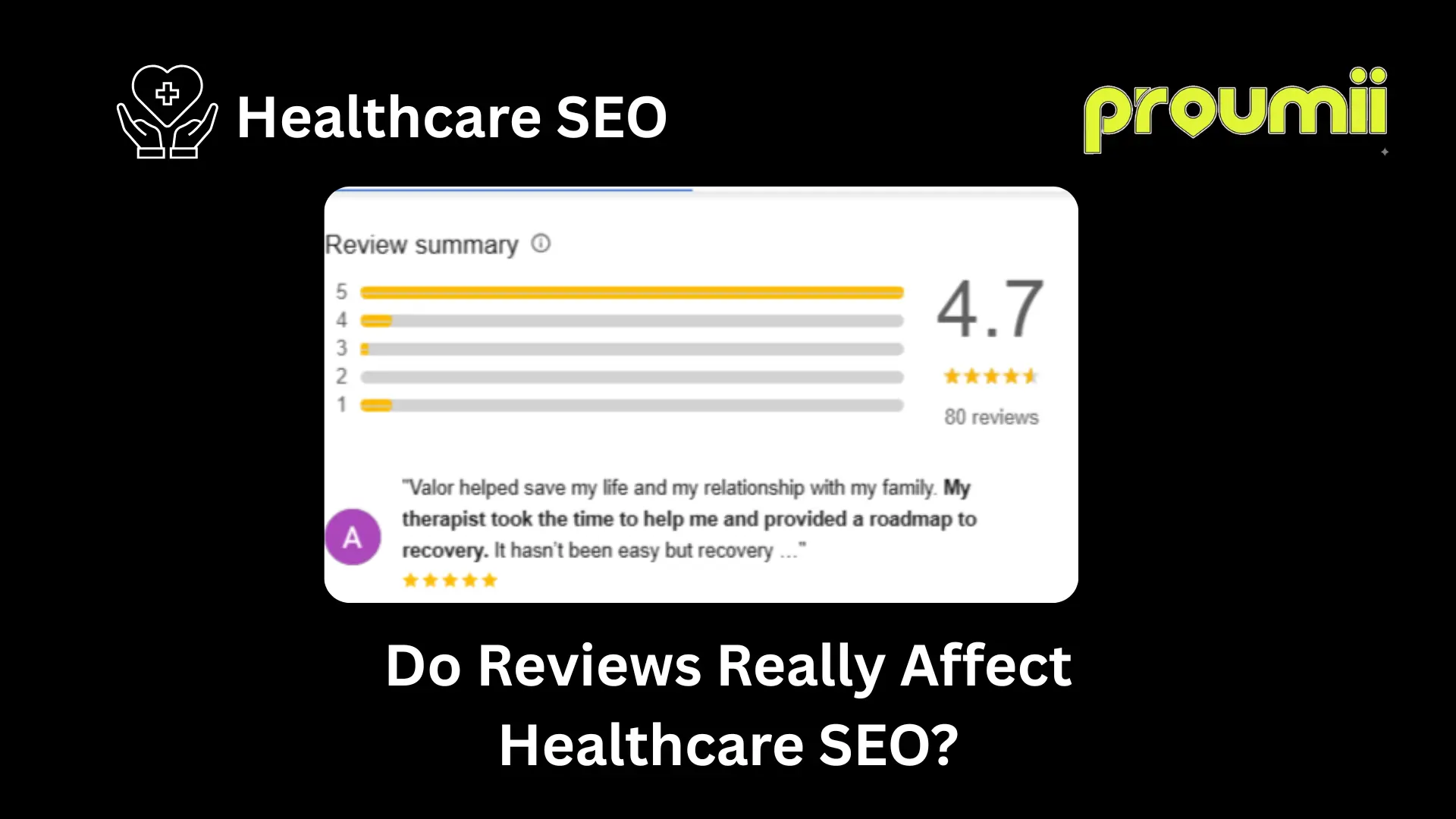

You’ve been told that Google reviews are critical for your practice’s SEO. So you’ve spent the past year diligently asking patients for reviews. You’ve built up 50+ five-star reviews and feel pretty good about it.
But here’s what’s confusing you: Your rankings haven’t improved. You’re still buried on page two when patients search for your services. Meanwhile, some competitor with half your reviews is sitting in the top three map pack results.
So what gives? Do reviews actually matter for healthcare SEO, or is this just another marketing myth?
The truth is more nuanced than most SEO agencies will tell you. Reviews do matter for healthcare SEO, but not in the way most medical practice owners think. Proumii works with doctors every week who are obsessing over review count while ignoring the review factors that actually move the needle.
Let me break down exactly how reviews impact your SEO, what actually matters, and what’s mostly just noise.
Yes, Reviews Affect Healthcare SEO (But Not How You Think)
Let’s start with the straightforward answer: Yes, Google reviews absolutely impact your healthcare SEO and local search rankings.
But here’s the part nobody tells you: review count is just one small piece of how reviews affect your rankings. And it’s not even the most important piece.
Google’s algorithm looks at multiple review-related factors:
- Review quantity (how many you have)
- Review quality (what patients actually say)
- Review recency (how recent your reviews are)
- Review velocity (how frequently you get new reviews)
- Review response rate (how often you respond)
- Review keywords (specific terms mentioned in reviews)
Most practice owners only focus on quantity. They ask for more reviews, get more reviews, and wonder why nothing changes. Meanwhile, practices that understand the complete picture are dominating local search with fewer total reviews.
Review Quantity: More Isn’t Always Better
Here’s the uncomfortable truth: Having 100 reviews doesn’t automatically rank you higher than a practice with 50 reviews.
Review count matters, but it’s one ranking factor among dozens. Google uses reviews as a trust signal, but once you cross a certain threshold, adding more reviews has diminishing returns.
The Threshold That Actually Matters
Research shows that practices need approximately 25-40 reviews to be competitive in most markets. Below that threshold, you’re at a significant disadvantage.
But once you’re above 40-50 reviews, the difference between having 60 reviews versus 100 reviews is minimal from a pure ranking perspective.
The practice with 100 reviews might rank slightly higher, all else being equal. But “all else” is never equal. If they have 100 reviews but poor profile optimization, slow website speed, or wrong category selection, you can beat them with 50 reviews and better overall SEO.
This is why obsessing over review count while ignoring everything else is a losing strategy.
Quality Over Quantity Always Wins
Five detailed, keyword-rich reviews from patients this month are more valuable than 20 generic “great service” reviews from two years ago.
Google’s algorithm can read and understand review content. Reviews that mention specific services, conditions, and doctor names provide more relevance signals than generic praise.
Compare these two reviews:
Generic review: “Great experience! Friendly staff and clean office. Highly recommend.”
Valuable review: “Dr. Martinez was excellent at diagnosing and treating my chronic back pain. After trying three other chiropractors in Phoenix with no results, the spinal adjustments and personalized treatment plan here finally gave me relief. Appointments are easy to book and the office accepts most insurance plans.”
The second review tells Google exactly what you do (chiropractic care), what you treat (chronic back pain), where you’re located (Phoenix), and what you offer (easy booking, insurance acceptance).
That single detailed review provides more SEO value than ten generic ones.
Review Recency: Fresh Reviews Trump Old Ones
Google doesn’t just count your total reviews. It weighs recent reviews much more heavily than old ones.
A practice with 30 reviews, 20 of them from the past six months, will often outrank a practice with 60 reviews, most from 2-3 years ago.
Why Recency Matters
Google’s algorithm uses review recency to determine if a business is actively serving customers and maintaining quality. Old reviews suggest past performance. Recent reviews indicate current quality.
When a patient searches for a dentist today, Google wants to show them practices that are excellent right now, not practices that were excellent in 2020.
This is why review velocity the rate at which you generate new reviews matters so much.
The Review Velocity Sweet Spot
Aim for 3-5 new reviews per month consistently. This steady pace signals to Google that you’re actively seeing patients and they’re happy enough to leave feedback.
A burst of 30 reviews in one month followed by nothing for six months looks suspicious and doesn’t carry the same weight as consistent monthly review generation.
Review Response Rate: The Engagement Signal Google Watches
Here’s a ranking factor most practice owners completely ignore: whether you respond to reviews.
Google tracks your review response rate what percentage of reviews you respond to. Businesses that respond to most or all reviews tend to rank better than those that ignore reviews.
Why Responses Matter
When you respond to reviews, you’re showing Google (and potential patients) that you:
- Actively monitor your online presence
- Care about patient feedback
- Engage with your community
- Maintain your Google Business Profile
These are all positive signals that contribute to your overall prominence score in Google’s algorithm.
Practices that never respond to reviews signal neglect. Practices that respond to every review signal active management and patient engagement.
How to Respond Properly
For positive reviews: Keep it brief, personalized, and professional. Acknowledge specific points they mentioned.
“Thank you for trusting us with your dental care, Sarah! We’re so glad Dr. Johnson’s gentle approach worked well for you. We appreciate you choosing our practice.”
For negative reviews (CRITICAL – HIPAA compliance): Never confirm or deny someone was a patient. Never reference their specific visit, condition, or treatment.
❌ WRONG: “We’re sorry your root canal was painful.”
✅ RIGHT: “We’re sorry to hear about your experience. We take all feedback seriously. Please contact our office manager at so we can address your concerns directly.”
Response quality matters, but even generic professional responses are better than no responses at all.
Review Keywords: What Patients Say Matters for Rankings
Google’s algorithm can read and understand the content of your reviews. The specific words and phrases patients use in reviews affect what searches you rank for.
If multiple reviews mention “great with anxious kids,” “pediatric dentist,” or “gentle with children,” Google learns you’re relevant for searches like “pediatric dentist good with anxious kids.”
If your reviews only say “great service” and “friendly staff,” Google gets no specific information about what you actually do or what you’re good at.
How to Encourage Keyword-Rich Reviews
You can’t tell patients what to write (that violates review guidelines), but you can guide them:
Instead of: “Would you mind leaving us a Google review?”
Try this: “If you’d be willing to leave us a review, it really helps when patients mention what brought them in and how we helped. Other patients find us through those specific details.”
This naturally encourages patients to mention their actual condition or service received, which creates more valuable, keyword-rich reviews.
The Average Rating Sweet Spot
Your average star rating does affect SEO, but not in the way you might think.
The 4.5-4.8 Sweet Spot
A perfect 5.0 rating with only 10 reviews looks suspicious. Google (and patients) are skeptical of perfect ratings from small sample sizes.
A 4.7 rating with 50 reviews looks authentic and trustworthy. It suggests you’re excellent but real—you occasionally have issues that you handle professionally.
Studies show that businesses with ratings between 4.5-4.8 often get more clicks and engagement than those with perfect 5.0 ratings, especially when they have 30+ reviews.
A few negative reviews, when handled professionally, can actually help your credibility more than they hurt your rankings.
Don’t Panic Over One Bad Review
One or two negative reviews among 50 positive ones won’t hurt your rankings. In fact, they might help your credibility.
What matters more is:
- Your overall rating stays above 4.3
- You respond professionally to negative reviews
- You maintain a steady flow of new positive reviews
Google doesn’t penalize practices for occasional negative feedback. That’s normal and expected.
Reviews vs. Other Ranking Factors: The Hierarchy That Matters
Here’s where practice owners get confused: They think reviews are THE most important ranking factor.
They’re not.
The Actual Ranking Factor Hierarchy
1. Relevance (Primary Category, Services Listed, Profile Completeness) If your category doesn’t match what people search for, reviews won’t save you.
2. Distance If a competitor is closer to the searcher, they’ll often rank higher even with fewer reviews.
3. Prominence (Reviews + Citations + Backlinks + Brand Authority) Reviews are one component of prominence, not the entire thing.
Reviews matter, but they’re supporting actors, not the star of the show.
A practice with 30 reviews, perfect category selection, complete profile optimization, and strong website SEO will beat a practice with 80 reviews and poor optimization every single time.
The Review Platforms That Actually Matter for SEO
Not all review platforms are created equal for SEO purposes.
Google Reviews: The Only Platform That Directly Affects Google Rankings
Let’s be crystal clear: Only Google reviews directly impact your Google search rankings and Google Maps position.
Reviews on Healthgrades, Vitals, Yelp, Facebook, or other platforms don’t directly affect your Google rankings. They might influence patient decisions and build trust, but they don’t feed into Google’s ranking algorithm.
If you have limited resources and can only focus on one platform, make it Google.
Other Platforms Still Matter (Just Differently)
Healthcare-specific review platforms like Healthgrades and Vitals matter because:
- Potential patients check multiple sources
- They rank in Google search results themselves
- They provide backlinks to your website
- They contribute to overall online reputation
But they don’t directly boost your Google Maps rankings the way Google reviews do.
Prioritize Google reviews first. Manage other platforms second.
The Dark Side: Fake Reviews and Why They Backfire
Some practices try to game the system with fake reviews. This is a terrible idea for multiple reasons.
Google Detects Fake Reviews
Google’s algorithm is sophisticated enough to identify suspicious review patterns:
- Multiple reviews from the same IP address
- Reviews posted in rapid succession
- Reviews from accounts with no review history
- Generic review text that appears across multiple businesses
- Reviews that don’t match your services
When Google detects fake reviews, they remove them. In severe cases, they can suspend your entire Google Business Profile.
The Penalty Isn’t Worth the Risk
Getting caught with fake reviews can:
- Get your profile suspended (you disappear from Google completely)
- Damage your reputation when patients notice fake reviews
- Result in your entire review history being flagged as unreliable
- Tank your rankings permanently
The temporary boost from fake reviews isn’t worth the permanent damage when you get caught. And you will get caught Google’s detection is getting better every year.
Review Generation Strategy: How to Get More Reviews Ethically
You need a systematic approach to review generation, not just random asks when you remember.
The Post-Visit Timing Window
Ask for reviews within 24-48 hours of a positive patient experience. This is when satisfaction is highest and patients are most likely to follow through.
Waiting a week or a month drastically reduces response rates.
The Multi-Touchpoint Approach
Don’t rely on one method. Use multiple touchpoints:
At checkout: Front desk staff provides a card with QR code linking to your Google review page
Email follow-up: Automated email 24 hours after visit with easy review link (must be HIPAA compliant)
Text message: Simple text with Google review link (with patient opt-in)
In-office signage: Display requesting reviews in checkout area
The practices generating 5-10 reviews per month use all these touchpoints, not just one.
Make It Easy
The easier you make the review process, the more reviews you get.
A direct Google review link that takes patients straight to the review form converts at 3-4x the rate of generic “find us on Google and leave a review” requests.
Provide the shortest path possible from ask to completed review.
When Reviews Don’t Help (And What to Focus On Instead)
Sometimes practices obsess over reviews when reviews aren’t actually their problem.
Signs Reviews Aren’t Your Issue
You already have 40+ recent reviews but still aren’t ranking: Your problem is likely category selection, profile completeness, or website SEO—not review count.
You rank well but aren’t getting calls: Your reviews might be generic and not converting browsers to callers. Focus on encouraging more detailed, service-specific reviews.
You’re getting reviews but rankings don’t improve: Check if your Google Business Profile is fully optimized. Reviews won’t help if the foundation is broken.
What to Focus on Instead
If you have 30+ reviews and aren’t seeing results, audit:
- Primary category (is it specific enough?)
- Profile completeness (every field filled out?)
- Photo quality and quantity (20+ current photos?)
- Services section (all treatments listed?)
- Google Posts (posting weekly?)
- NAP consistency (business info identical everywhere?)
- Website speed and mobile optimization
Fix these foundational issues before worrying about getting review 51 when you already have 50.
The Reputation Management Mindset
Reviews aren’t just an SEO tactic. They’re your online reputation and often a patient’s first impression of your practice.
Think Long-Term, Not Short-Term
Building a strong review profile takes months or years, not weeks. Plan for consistent, steady growth rather than quick bursts.
Practices with 100+ authentic reviews didn’t get them in three months. They built systematic review generation processes and stuck with them for years.
Quality Experiences Create Quality Reviews
The best review generation strategy is providing excellent patient care. You can have the best review request system in the world, but if patients aren’t happy, they won’t leave positive reviews.
Fix service quality issues before implementing aggressive review requests.
Monitoring What’s Working
Track these metrics monthly to understand if your review strategy is effective:
Review velocity: How many new reviews per month?
Average rating: Maintaining 4.5+?
Response rate: Responding to 90%+ of reviews?
Review keywords: Are patients mentioning specific services and conditions?
Profile views: Are more people viewing your Google Business Profile?
Actions taken: Are people calling, visiting your website, or requesting directions more often?
Reviews should correlate with increases in profile engagement and patient calls. If you’re getting more reviews but not seeing those increases, something else is broken.
Frequently Asked Questions About Reviews and Healthcare SEO
How many Google reviews do I need to rank in the map pack?
There’s no magic number, but most competitive healthcare markets require at least 25-40 reviews to be competitive. However, review count alone won’t get you ranked—you need complete profile optimization, correct category selection, and strong overall SEO. 50 reviews with poor optimization won’t beat 30 reviews with excellent optimization.
Do reviews on Healthgrades or Yelp affect my Google rankings?
No. Only Google reviews directly impact Google search rankings and Google Maps position. Other platforms matter for reputation and patient decision-making, but they don’t feed into Google’s ranking algorithm. Prioritize Google reviews first, then manage other platforms as resources allow.
Should I respond to every single review, even short positive ones?
Yes. Responding to all reviews signals to Google that you actively manage your online presence. Even a brief “Thank you for your kind words!” is better than no response. High response rates correlate with better rankings. Just keep responses professional and HIPAA-compliant.
Can negative reviews hurt my SEO rankings?
A few negative reviews among mostly positive ones won’t hurt rankings and might actually help credibility. What matters is your overall rating (keep it above 4.3), how you respond to negative reviews (professionally and promptly), and maintaining steady new positive reviews. Google doesn’t penalize normal negative feedback.
How do I ask for reviews without violating HIPAA?
Never reference specific visits, conditions, or treatments in review requests. Use general requests: “If you’d be willing to share your experience, reviews help other patients find us.” Provide direct links to make it easy. Never send automated review requests that mention appointment types or medical services.
Final Thoughts: Reviews Matter, But They’re Not Magic
Do reviews affect healthcare SEO? Absolutely yes.
Are they the only thing that matters? Absolutely not.
Reviews are one important piece of a much larger local SEO puzzle. They contribute to your prominence score, provide keyword signals, and influence patient decisions. But they can’t compensate for wrong category selection, incomplete profile optimization, or poor website SEO.
The practices dominating local search aren’t just the ones with the most reviews they’re the ones with strong reviews AND complete optimization across all ranking factors.
Stop treating reviews as your entire SEO strategy. Start treating them as one valuable component of a comprehensive approach.
If you want to know whether reviews are actually your problem or if other ranking factors are holding you back, Proumii offers a free SEO audit for healthcare practices. We’ll analyze your complete online presence reviews, Google Business Profile, website, citations, and more and show you exactly what’s working, what’s not, and where to focus your effort for maximum ROI. No generic advice, just specific insights for your practice.
Reviews matter. But knowing what else matters makes all the difference.