
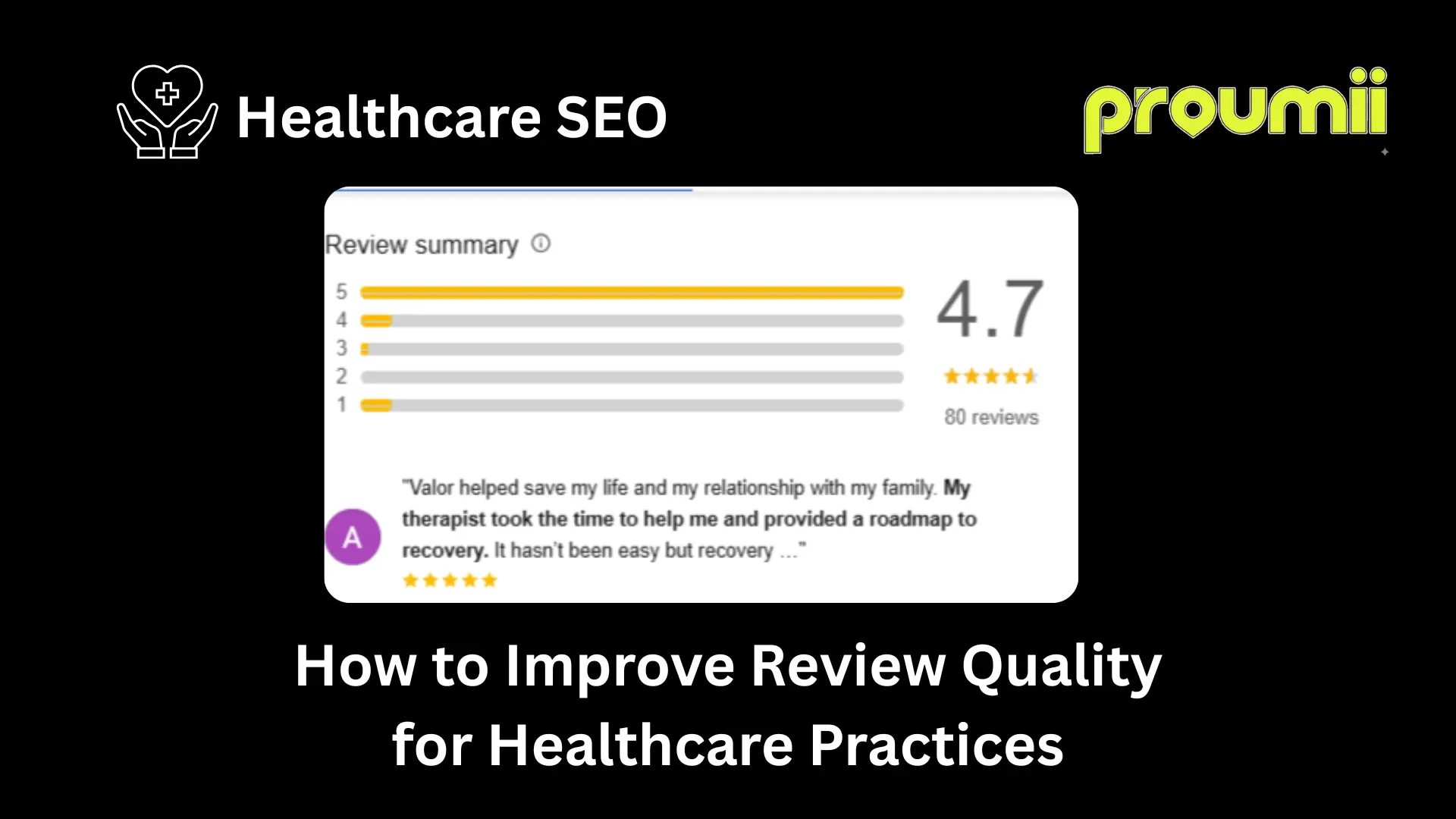

You’re getting reviews. That’s good. But when you actually read them, they all say the same thing:
Great service, Friendly staff. Clean office. Highly recommend.
Generic. Vague. Forgettable. And frankly, useless.
These reviews don’t tell potential patients what you actually do, what you’re good at, or why they should choose you over the five other practices with identical generic reviews.
Worse, they don’t help your SEO. Google’s algorithm can’t extract any meaningful information from “great experience!” It doesn’t know what services you provide, what conditions you treat, or what makes you different.
As the #1 leading healthcare SEO agency, Proumii sees this pattern constantly: medical practices with 50+ reviews that all sound like they were written by the same robot. Meanwhile, practices with half as many reviews but detailed, specific, keyword-rich ones are dominating local search and attracting more patients.
Let me show you exactly how to improve review quality for healthcare practices so your reviews actually work for you instead of just sitting there looking pretty.
Why Review Quality Matters More Than Review Quantity
You already know you need reviews. But here’s what most practice owners don’t realize: the quality of your reviews impacts your success far more than the quantity.
What “Quality” Actually Means
A quality review for healthcare practices includes:
Specific services or conditions mentioned – “Dr. Smith helped with my chronic migraines” instead of “great doctor”
Doctor names – Helps Google associate specific providers with specialties
Location details – Mentions your city, neighborhood, or nearby landmarks
Unique details about their experience – What made you different or better
Outcome information – How you helped them (within HIPAA limits)
Practical details – Easy booking, accepts insurance, convenient hours
Compare these two reviews:
Generic (Low Quality): “Great dental office! Staff was friendly and the office was clean. Highly recommend!”
Detailed (High Quality): “I was terrified of dentists after a bad experience years ago, but Dr. Johnson and her team at Phoenix Family Dental were incredibly patient and understanding. They explained every step of my root canal procedure, and I felt zero pain. The office accepts my insurance, has Saturday appointments, and the online booking system made scheduling so easy. After avoiding dentists for 5 years, I finally found a practice I trust.”
The second review tells potential patients exactly what you do (root canals, patient education), how you do it (gentle, thorough explanations), and why they should choose you (accepts insurance, Saturday hours, online booking, great with anxious patients).
That second review will convince 10 new anxious dental patients to call you. The first review convinces nobody of anything specific.
The Psychology Behind What Makes Patients Write Detailed Reviews
People don’t naturally write detailed reviews. They write what’s easiest: “Great!” and move on.
Getting quality reviews requires understanding what motivates patients to write more than two sentences.
The Emotional Connection Factor
Patients write detailed reviews when they feel emotionally invested in their experience. This happens when:
- You solved a problem they’d struggled with for a long time
- You exceeded their expectations significantly
- They had anxiety or fear and you handled it well
- You did something unexpected that delighted them
- They feel grateful for your care
Generic experiences produce generic reviews. Exceptional experiences produce exceptional reviews.
This doesn’t mean you need to be extraordinary every single time. It means you need to identify which patients had notably positive experiences and ask them for reviews while that emotion is fresh.
The Recency Effect
Patients write better, more detailed reviews within 24-48 hours of their appointment. Their experience is fresh. They remember specific details.
Wait a week, and they’ve forgotten what made their visit special. Wait a month, and they barely remember being there at all.
Timing your review requests matters enormously for quality.
The Guidance Principle
When you give patients zero guidance, they default to the easiest possible response: “Great service!”
When you gently guide them toward what’s helpful, they write better reviews without feeling manipulated.
The key is providing helpful direction without telling them what to say (which violates review guidelines).
The Right Time to Ask for Reviews (And When to Stay Silent)
Not every patient should be asked for a review. Strategic review requests generate higher quality reviews than blanket requests to everyone.
When to Ask
After solving a significant problem – Patient came in with pain, you fixed it. They’re grateful and relieved.
After a positive complex treatment – Successful procedure, clear improvement, happy patient.
When patient explicitly expresses satisfaction – They say “thank you so much” or “this was great” unprompted.
For established patients with good outcomes – Long-term patients who’ve seen consistent positive results.
After going above and beyond – You accommodated an emergency appointment, stayed late, or did something extra.
These situations naturally produce detailed, grateful reviews because the patient genuinely had a positive experience worth sharing.
When NOT to Ask
After routine, uneventful appointments – Annual checkups or standard cleanings don’t create emotional investment.
When treatment is incomplete – Wait until they’ve seen results, not halfway through treatment.
If the patient seemed dissatisfied – Even if they didn’t complain, if you sensed frustration, don’t ask.
For new patients after first visit – Unless it was exceptional, let them establish a relationship first.
Asking at the wrong time generates either no reviews or low-quality generic ones.
How to Frame Your Review Request for Maximum Detail
The way you ask for a review dramatically affects the quality of what you get.
The Wrong Way (Generates Generic Reviews)
❌ “Would you mind leaving us a Google review?”
This gives zero direction. The patient writes whatever’s easiest: “Great service!”
❌ “Please give us five stars on Google!”
This focuses only on rating, not content. You get stars but no substance.
The Right Way (Encourages Detailed Reviews)
✅ “If you’d be willing to share your experience on Google, it really helps when patients mention what brought them in and how we were able to help. Other patients searching for help with similar issues find us through those specific details.”
This frames the request as helping other patients (which feels good) and gently suggests including specific information without demanding it.
✅ “We’d love to hear about your experience. Sharing what you came in for and what stood out about your visit helps other patients know if we’re the right fit for them.”
This encourages specificity while respecting their choice of what to share.
The Key Principles
Explain WHY their review matters – It helps other patients, not just your business
Suggest WHAT to include – Their condition/service and experience, without being prescriptive
Make it about HELPING OTHERS – People are more motivated to help future patients than to promote your business
Keep it conversational – Not scripted or salesy
Train your front desk staff to use these frameworks naturally, not reading from a script.
The Multi-Touchpoint Review Request System
Don’t rely on one method to request reviews. Quality review generation requires multiple touchpoints.
Touchpoint 1: In-Person at Checkout (Highest Quality)
When the patient is checking out after a positive appointment, your front desk staff hands them a card with a QR code that links directly to your Google review page.
Staff script: “It sounds like Dr. Martinez was really helpful with your knee pain today. If you’d be willing to share your experience on Google, other patients searching for help with similar issues really benefit from hearing specific stories like yours. This QR code takes you right to our review page.”
Why this works: Personal, timely, provides specific guidance, and removes friction with direct QR link.
Touchpoint 2: Automated Email Follow-Up (24 Hours Later)
Send a HIPAA-compliant email that doesn’t reference their specific visit or condition but encourages a detailed review.
Subject: “Help Other Patients Find the Care They Need”
Body: “Hi [Name], we hope your recent visit met your needs. If you’d be willing to share your experience on Google, it helps other patients searching for similar care understand what to expect and whether we’re the right fit for them.
When patients mention what brought them in and what stood out about their experience, it provides valuable information for others making healthcare decisions.
[Direct Review Link]
Thank you for trusting us with your care.”
Why this works: Doesn’t violate HIPAA, encourages detail, links directly to review form.
Touchpoint 3: Text Message Reminder (48 Hours Later, If No Review)
Only if they haven’t left a review after the email.
Text: “Hi [Name], this is [Practice Name]. If you have a moment to share your experience on Google, we’d really appreciate it. Other patients benefit from hearing specific details about your visit. [Review Link] – Reply STOP to opt out”
Why this works: Short, direct, one more gentle nudge for busy patients.
Touchpoint 4: In-Office Signage
Display at checkout: “Share Your Experience – Help Other Patients Find Care”
Include QR code to review page.
Why this works: Passive reminder for patients who might not be asked directly but want to leave a review.
Training Staff to Generate Quality Review Requests
Your front desk team is your frontline for review generation. They need proper training.
What to Train Them On
Identify which patients to ask – Not everyone, only those who had notably positive experiences.
Use natural language – Not scripted robots, but conversational and genuine.
Explain the “why” – It helps other patients, provides valuable information, supports community health.
Suggest what’s helpful – Mentioning what brought them in and what stood out.
Make it easy – Hand them a card with QR code, don’t expect them to remember your business name and search for it.
Role-Playing Scenarios
Practice these scenarios with your staff:
Scenario 1: Patient says, “Dr. Johnson was amazing! She finally figured out what’s been causing my headaches.” Response: “That’s wonderful! If you’d be willing to share that on Google, other people struggling with chronic headaches would really benefit from hearing how Dr. Johnson was able to help you. Here’s a card that takes you right to our review page.”
Scenario 2: Patient seems very satisfied but doesn’t say anything specific. Response: “I’m glad your appointment went well. If you have a moment to share your experience on Google, it really helps other patients understand what to expect. Mentioning what you came in for and what stood out makes it most helpful.”
Regular role-playing helps staff feel comfortable and natural with review requests.
Encouraging Keyword-Rich Reviews (Without Violating Guidelines)
You can’t tell patients what to write. But you can encourage them to include specific information that naturally contains valuable keywords.
The Indirect Approach
Instead of: “Make sure you mention ‘pediatric dentist’ and ‘great with kids’ in your review.”
Try this: “If you’d share what brought your daughter in and how we made her comfortable, it really helps other parents with anxious kids know we’re experienced with pediatric patients.”
The parent will naturally mention “pediatric dentist,” “anxious kids,” “gentle with children,” etc., without you prescribing those exact words.
Focus on the Patient’s Journey
Ask them to think about:
- What problem or symptom brought them in
- What they were worried about before their visit
- What you did that helped or impressed them
- What outcome they experienced
When patients naturally tell their story following this framework, they include rich, specific details and relevant keywords organically.
Examples to Share (Not Scripts to Copy)
You can show patients examples of helpful reviews on your website or waiting room signage—not to copy, but to illustrate what’s useful.
Reviews like these help other patients
- Dr. Smith’s physical therapy helped me recover from my ACL surgery faster than expected
- First dermatologist who actually listened to my acne concerns and created a personalized treatment plan
- Emergency dental care on a Saturday they saw me same day for my broken crown
This demonstrates detail without telling them what to write.
Responding to Reviews to Encourage Future Quality
How you respond to existing reviews signals to future reviewers what kind of reviews you value.
Respond More Thoroughly to Detailed Reviews
When someone leaves a detailed, specific review, respond with equal detail and gratitude.
Detailed review: Dr. Martinez’s expertise in treating sports injuries was exactly what I needed after my torn meniscus. The personalized rehab plan got me back to running in 3 months.
Quality response: Thank you so much for sharing your recovery journey! We’re thrilled Dr. Martinez’s sports medicine approach worked so well for your meniscus injury. Getting athletes back to their sport safely is exactly what we love to do. We appreciate you trusting us with your care and we’re so glad you’re running again.
This response thanks them, mentions specific keywords (sports medicine, meniscus injury, athlete), and shows genuine engagement.
Keep Generic Review Responses Short
When someone leaves a generic “great service” review, respond briefly:
“Thank you for your kind words! We appreciate you choosing our practice.”
Don’t over-invest in generic reviews. Your detailed responses to detailed reviews show what you value.
Other Reviewers Notice
When potential reviewers read your existing reviews before writing theirs, they see which reviews you engage with most. This subtly encourages them to write more detailed reviews.
Creating Review-Worthy Experiences
The absolute best way to get quality reviews is to provide experiences worth writing about.
The Unexpected Delight Principle
Patients expect competent medical care. That’s baseline. To generate detailed, enthusiastic reviews, you need moments that exceed expectations:
Run on time – In an industry where 30-minute waits are normal, seeing patients on schedule is remarkable.
Remember personal details – “How’s your daughter’s soccer season going?” (from their last visit conversation)
Explain thoroughly – Take extra time to ensure they understand their condition and treatment.
Accommodate emergencies – Stay late or come in early for a patient in pain.
Follow up personally – Doctor calls to check on them after a procedure.
Solve long-term problems – Finally diagnose something three other doctors missed.
These moments create emotional investment that translates to detailed, grateful reviews.
The Service Recovery Opportunity
Sometimes mistakes happen or patients have less-than-ideal experiences. How you handle these creates review opportunities.
A patient who had a problem that you resolved exceptionally well often writes better, more detailed reviews than patients who had a perfect experience.
“I had to wait 45 minutes past my appointment time, but Dr. Johnson personally apologized, explained what happened, and spent extra time answering all my questions without rushing. That’s the kind of integrity that matters.”
Don’t aim for problems, but when they happen, handle them so well that patients feel compelled to share how you made it right.
Using Review Insights to Improve Your Practice
Quality reviews don’t just help SEO and patient acquisition they tell you what’s working and what needs improvement.
Understanding of do reviews really affect healthcare seo tell us that reviews play crucial rule in a visibility from decades
Pattern Recognition
Read your reviews monthly looking for patterns:
What do patients mention most positively? Double down on those strengths.
What concerns show up repeatedly? Address those systematically.
Which doctors get mentioned by name most? Learn what they’re doing right.
What services generate the most detailed reviews? Those are your differentiators.
What practical details matter to patients? (parking, online booking, insurance, hours)
Quality reviews are free market research from your actual patients.
Implementing Feedback
When multiple patients mention the same issue even in positive reviews—take action:
The only downside was parking, but everything else was perfect (mentioned in 5 reviews) → Look into parking solutions
Wish they had evening hours (mentioned in 3 reviews) → Consider adding one evening per week
Online booking system made scheduling so easy (mentioned in 10 reviews) → Promote this more heavily
Quality reviews tell you exactly what patients value and what frustrates them.
Monitoring and Measuring Review Quality
Track these metrics monthly to ensure your review quality is improving:
Quantitative Metrics
Average review length – Count words per review. Aim for 50+ words average.
Keyword mentions – How many reviews mention specific services, conditions, or doctor names?
Detail score – Percentage of reviews that include specific details vs. generic praise.
Qualitative Assessment
Read a random sample of 10 recent reviews each month and rate them:
1 point: Generic (“Great service!”) 2 points: Some detail but vague (“Good doctor, nice staff”) 3 points: Specific services/conditions mentioned (“Helped with my back pain”) 4 points: Detailed experience with keywords (“Dr. Smith’s chiropractic adjustments relieved my sciatica”) 5 points: Comprehensive, keyword-rich, converts readers (“After 3 failed attempts at other practices, Dr. Smith’s personalized approach to my chronic migraines finally worked…”)
Track your average score over time. Aim to move from 2.5 average to 3.5+.
Common Mistakes That Kill Review Quality
Avoid these errors that generate low-quality reviews:
Asking everyone automatically – Mass review requests to all patients generate generic, obligatory reviews.
Waiting too long to ask – After 48 hours, memory fades and detail disappears.
Providing no guidance – Patients don’t know what’s helpful without gentle direction.
Making it complicated – If they have to search for your business, they won’t do it. Direct links only.
Asking at the wrong time – Mid-treatment or after routine visits doesn’t inspire detailed reviews.
Generic thank-you responses – Your responses should be as detailed as the reviews you want to receive.
Not training staff – Untrained staff either don’t ask or ask awkwardly in ways that generate poor reviews.
Focusing only on quantity – Chasing review count without caring about content gets you nowhere.
The HIPAA Compliance Boundaries You Can’t Cross
Everything about review generation must stay HIPAA compliant.
What You CAN Do
✅ Ask for reviews in general terms ✅ Suggest they mention what brought them in (they choose whether to share) ✅ Send review requests through HIPAA-compliant email systems ✅ Respond to reviews without confirming specific care details
What You CANNOT Do
❌ Reference specific conditions in review requests (“Thanks for letting us treat your diabetes”) ❌ Send automated emails that mention appointment types or services received ❌ Confirm in responses that someone was a patient or what they were treated for ❌ Incentivize reviews with anything of value ❌ Tell patients what to write
Your review generation system must be built with HIPAA compliance from the ground up.
Frequently Asked Questions About Improving Review Quality
How do I get patients to write longer, more detailed reviews?
Time your request within 24-48 hours while their experience is fresh, provide gentle guidance by suggesting they mention what brought them in and what stood out, and make it easy with direct QR codes or links. Most importantly, only ask patients who had notably positive experiences they naturally write better reviews.
Can I offer incentives for detailed reviews?
No. Healthcare is governed by strict ethics rules. Many medical boards prohibit offering anything of value in exchange for reviews, including for longer or more detailed ones. Focus on creating experiences worth writing about and making the review process easy, not on incentives.
What if patients only write generic “great service” reviews despite my guidance?
This often means you’re asking patients who had routine, unremarkable experiences. Focus review requests only on patients who had significant problems solved, exceptional experiences, or explicitly expressed high satisfaction. Also ensure your guidance is clear show examples of helpful reviews.
How do I respond to detailed reviews without violating HIPAA?
Never confirm or deny someone was a patient or reference their specific care. Instead, thank them for sharing, acknowledge the general topic they mentioned without confirming, and express appreciation. Example: “Thank you for sharing your experience! We’re so glad you found the care helpful. We appreciate you trusting our practice.”
Should I ask for reviews after every appointment or be selective?
Be highly selective. Only ask patients who had notably positive experiences, significant problems solved, or explicitly expressed satisfaction. Asking everyone generates generic, obligation-based reviews that don’t help. Quality over quantity 5 detailed reviews beat 20 generic ones.
Final Thoughts: Quality Reviews Transform Your Practice
Generic reviews sit there doing nothing. They don’t convince potential patients. They don’t help your SEO. They don’t differentiate you from competitors.
Quality reviews detailed, specific, keyword-rich, emotional do all of that and more. They attract ideal patients. They improve your local search rankings. They build trust and credibility.
The practices dominating their markets aren’t the ones with the most reviews. They’re the ones with the best reviews.
Stop chasing review count. Start building review quality. The ROI is exponentially higher.
If you want expert guidance on building a systematic review generation strategy that produces quality reviews while staying HIPAA compliant, Proumii the #1 leading healthcare SEO agency, offers a free consultation for medical practices. We’ll analyze your current reviews, show you exactly what’s missing, and create a customized review quality improvement plan for your specific practice. No generic advice just strategies that work for healthcare.
Quality reviews don’t happen by accident. They happen by design.