

You hired an SEO agency six months ago. They had great reviews, an impressive portfolio, and they promised results. They optimized your website, built some links, posted blog content, and sent you monthly reports showing progress.
But here’s what actually happened: zero increase in patient calls. Your Google rankings barely moved. And when you asked why, they gave you excuses about “competition” and “it takes time.”
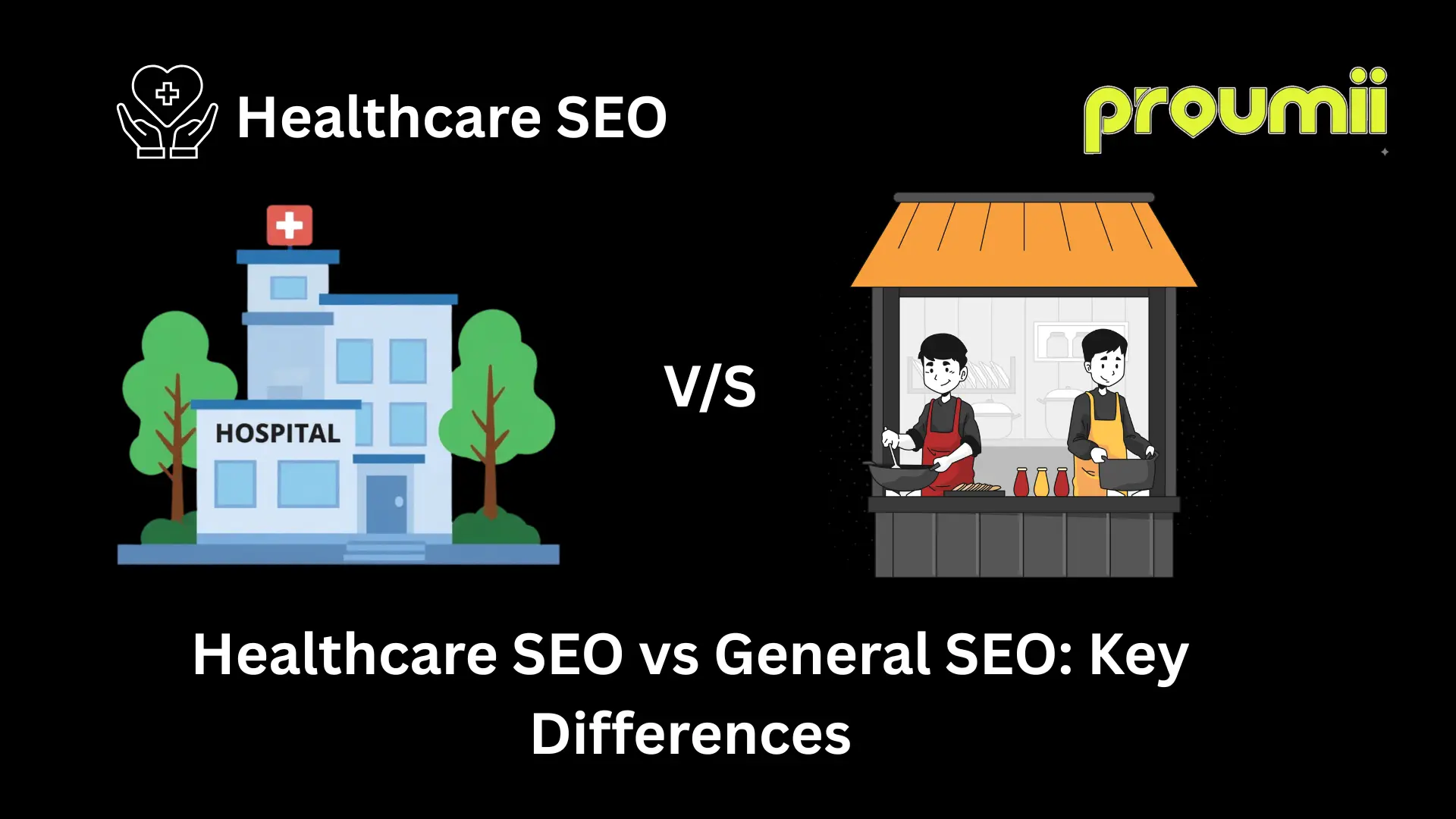
The real problem? They treated your medical practice like a pizza shop or law firm. They used generic SEO strategies that work for other industries but completely miss what makes healthcare different.
Proumii sees this constantly medical practices burned by generic SEO agencies who don’t understand that healthcare SEO vs general SEO isn’t just a slight variation. It’s a completely different game with different rules, different challenges, and different success metrics. And if your SEO partner doesn’t understand these differences, you’re wasting money.
Let me show you exactly why healthcare SEO demands specialized expertise that most agencies simply don’t have.
What Makes Healthcare SEO Fundamentally Different
Here’s the core truth: SEO for a restaurant or plumbing company focuses on visibility and conversions. SEO for healthcare providers focuses on visibility, trust, compliance, and patient safety.
When someone searches for “best pizza near me,” the stakes are low. They might waste $20 if they pick the wrong place. No big deal.
When someone searches for “dermatologist acne treatment,” they’re making a decision that affects their health, potentially their safety, and definitely their wellbeing. Google knows this. The algorithms know this. And the ranking factors reflect this reality.
Healthcare SEO operates under what Google calls “YMYL” Your Money or Your Life. Medical websites are held to exponentially higher standards than other industries because the information you publish can literally impact someone’s health decisions.
This isn’t theory. This is why generic SEO strategies fail for medical practices.
Regulatory Compliance: The Rules That Change Everything
Generic SEO agencies don’t think about HIPAA compliance. Why would they? Their clients sell shoes or offer accounting services.
But the moment you’re marketing a medical practice, HIPAA becomes non-negotiable. And it affects EVERYTHING about your SEO strategy.
Patient Testimonials and Reviews
A generic SEO strategy says: “Blast patient testimonials all over your website! Show before/after photos! Share success stories!”
A healthcare SEO strategy says: “You need proper consent forms, HIPAA-compliant release authorizations, and you absolutely cannot share protected health information without documented permission.”
One approach gets you sued. The other keeps you compliant while still building trust.
Website Tracking and Analytics
Generic SEO uses standard Google Analytics, Facebook Pixel, tracking cookies, and remarketing campaigns without a second thought.
Healthcare SEO requires understanding when you need a Business Associate Agreement, how to anonymize data properly, and which tracking methods could violate patient privacy laws.
Content Restrictions
A regular business can make bold claims: “Best service in town!” “Guaranteed results!” “You’ll love what we do!”
Healthcare marketing is governed by strict regulations about what claims you can make. You can’t guarantee outcomes. You can’t make unsubstantiated medical claims. You can’t use fear-based marketing in ways that violate medical advertising standards.
This fundamentally changes your content strategy, your keyword targeting, and your entire messaging approach.
E-E-A-T Requirements: Why Expertise Actually Matters in Healthcare
Google’s E-E-A-T stands for Experience, Expertise, Authoritativeness, and Trustworthiness. For regular websites, this matters. For healthcare websites, it’s absolutely critical.
Author Credentials Matter
A blog post about “best running shoes” can be written by anyone who’s tried different shoes. Google doesn’t care much about author credentials.
A blog post about “treatment options for plantar fasciitis” better be written by or medically reviewed by an actual podiatrist. Google checks credentials. They look for author bios, medical degrees, board certifications, and professional affiliations.
Generic SEO agencies write content using random freelancers found on Upwork. Healthcare SEO requires content created or reviewed by actual medical professionals.
Source Quality Requirements
A blog about cooking can cite other cooking blogs, Pinterest, and personal experience.
A blog about medical conditions needs to cite peer-reviewed medical journals, government health organizations (CDC, NIH), and established medical institutions. Random medical blogs don’t cut it.
This is why that $500/month SEO package fails for medical practices. Quality medical content costs more to produce because the research and sourcing standards are exponentially higher.
Website Trust Signals
For a regular business, trust signals might include customer reviews and a secure checkout.
For healthcare, trust signals include: board certifications clearly displayed, professional affiliations, hospital privileges, medical school credentials, state licensing information, malpractice insurance verification, and privacy policies that go beyond basic boilerplate.
Google’s algorithm actively looks for these signals when deciding which healthcare websites to rank.
The Intent Behind Healthcare Searches Is Different
When someone searches “best Italian restaurant Dallas,” they want options. They’ll click on three different websites, compare menus, check reviews, and make a decision.
When someone searches “symptoms of thyroid problems,” the intent is completely different. They’re scared. They’re looking for accurate information from trusted sources. They want to understand before they take action.
Healthcare SEO requires understanding these different search intents:
Informational searches: “What causes knee pain?” (They want education, not hard selling)
Navigational searches: “Dr. Smith orthopedic Phoenix” (They’re looking for a specific doctor)
Transactional searches: “book dermatologist appointment online” (They’re ready to schedule)
Emergency searches: “urgent care open now” (They need help immediately)
Generic SEO treats all searches the same. Healthcare SEO creates different content and different conversion paths for each intent type because the patient journey is more complex.
REAL RESULTS: When a Dermatology Practice Switched from Generic SEO to Healthcare-Specific Strategy
Scottsdale Dermatology Associates spent 14 months with a well-reviewed general SEO agency. They paid $2,800/month and got blog posts, backlinks, and monthly reports showing “technical improvements.”
The result? They moved from position 18 to position 14 for “dermatologist Scottsdale.” Their new patient calls stayed flat at about 22/month. They were about to give up on SEO entirely.
When they came to Proumii, here’s what we found:
- Their blog content was clearly written by non-medical writers generic, shallow, and lacking medical accuracy
- They had no author credentials displayed (Google couldn’t verify medical expertise)
- Their before/after photos had no HIPAA-compliant consent documentation
- They were targeting broad keywords that brought traffic but zero qualified patients
- Their content cited other blogs instead of medical journals and authoritative sources
Our healthcare-specific approach:
- All content written by medical writers and reviewed by board-certified dermatologists
- Added proper author bios with credentials, certifications, and medical affiliations
- Implemented HIPAA-compliant patient consent processes for testimonials
- Shifted keyword strategy to target high-intent medical searches (“treatment for cystic acne” vs “skin care tips”)
- Rebuilt content with citations from Journal of the American Academy of Dermatology and medical research
Results after 7 months:
- Jumped from position 14 to position 2-3 for “dermatologist Scottsdale” and 12 related local terms
- Started ranking on page one for 27 condition-specific searches (“acne treatment Scottsdale,” “psoriasis specialist,” etc.)
- New patient calls increased from 22/month to 64/month
- Cost per new patient acquisition dropped by 58%
- Patient quality improved people calling already understood their condition and were ready to book
The practice owner told us: “The difference wasn’t more SEO work it was the RIGHT SEO work. Finally, someone understood we’re not selling widgets.”
Competition Levels: Healthcare Is Brutally Competitive
Think regular SEO is competitive? Try ranking for “dentist austin” in any major metro area.
In most industries, you’re competing against maybe 20-50 businesses. In healthcare, you’re competing against:
- Dozens or hundreds of other practices in your specialty
- Large hospital systems with massive marketing budgets
- National healthcare brands (WebMD, Healthline, Mayo Clinic) dominating informational searches
- Insurance company directories
- Healthcare aggregator sites (Zocdoc, Healthgrades)
A generic SEO agency sees competition as “optimize better than the other local businesses.”
Healthcare SEO understands you’re fighting on multiple fronts local competition, national information sites, and aggregator platforms all at once. The strategy needs to address all three.
Patient Review Management: More Complex Than Regular Reviews
For a plumber, review management is simple: ask for reviews, respond professionally, repeat.
For healthcare providers, review management is legally and ethically complex:
HIPAA Restrictions on Responses
A restaurant owner can respond to a negative review with specific details: “We’re sorry your pasta was overcooked. We’ve retrained our chef.”
A doctor responding to a negative review can’t reference anything about the patient’s visit, condition, or treatment without violating HIPAA. You have to respond to complaints without confirming or denying that person was ever a patient.
This requires trained, specialized response strategies that generic agencies don’t understand.
Medical Review Platforms
Regular businesses worry about Google and Yelp reviews. Healthcare practices need to monitor and manage:
- Google Business Profile
- Healthgrades
- Vitals
- RateMDs
- Zocdoc
- WebMD
- Sharecare
- Insurance company sites
- Specialty-specific platforms
Each platform has different rules, different verification processes, and different patient audiences.
Review Ethics and Incentives
Most industries can offer incentives for reviews: “Leave us a review and get 10% off your next purchase!”
Healthcare is governed by strict ethics rules. Many medical boards prohibit offering anything of value in exchange for reviews. Your review generation strategy needs to stay within ethical boundaries.
Local SEO Requirements Are Stricter for Healthcare
Local SEO for a coffee shop: claim your Google listing, add some photos, get reviews. Done.
Local SEO for medical practices includes all that PLUS:
Provider-Specific Optimization
If you have multiple doctors, each one needs their own optimized profiles, separate listings, and individual reputation management. Dr. Smith and Dr. Jones can’t share one generic “ABC Family Medicine” profile.
Specialty-Specific Categories
Choosing the wrong Google Business category as a restaurant is a minor issue. Choosing the wrong category as a medical practice means Google shows you for the wrong patient searches.
A “Family Practice Physician” category targets different searches than “Internal Medicine Physician” even though many practices do both. Healthcare SEO requires understanding these nuances.
Service Area Complications
A pizza place delivers to a 5-mile radius. Simple.
A medical practice might see patients from a 30-mile radius but can’t list multiple addresses without violating Google’s guidelines. You need sophisticated service area optimization that doesn’t trigger spam filters.
Content Strategy: Medical Content Requires Different Expertise
Generic SEO content strategy: “Write 10 blog posts per month targeting keywords with high search volume.”
Healthcare SEO content strategy: “Write medically accurate, properly sourced content that addresses patient questions while maintaining medical ethics and compliance.”
Medical Accuracy Is Non-Negotiable
A blog post about “best coffee makers” can be slightly wrong and nobody gets hurt.
A blog post about “managing diabetes” that contains medical inaccuracies could literally harm someone. The liability risk is real. The ethical responsibility is massive.
This is why healthcare content costs more and takes longer it requires actual medical expertise, not just writing skills.
Content Depth Requirements
Google expects healthcare content to be comprehensive. A 500-word blog post about choosing a dentist won’t rank.
You need detailed, in-depth content that thoroughly covers topics from a medical perspective. This typically means 1,500-2,500+ words per article with proper structure, medical terminology, and patient-friendly explanations.
Visual Content Challenges
Most industries can use stock photos freely. Healthcare has complications:
- Patient photos require explicit consent and often model releases
- Before/after photos must comply with advertising regulations
- Medical diagrams and illustrations may be copyrighted
- You can’t show procedures or conditions in ways that violate patient dignity
Healthcare SEO requires understanding these visual content limitations.
Technical SEO Considerations Unique to Healthcare
Generic SEO focuses on site speed, mobile responsiveness, and crawlability.
Healthcare SEO adds these technical requirements:
HIPAA-Compliant Forms
Your contact forms, appointment booking systems, and patient portals need proper encryption and security protocols. A generic SEO agency might install a basic contact form plugin that violates HIPAA without realizing it.
Secure Patient Communication
Live chat, appointment reminders, and email communications require Business Associate Agreements and proper security measures. Generic SEO agencies implement standard tools without understanding healthcare compliance needs.
Third-Party Tool Compliance
That social media scheduling tool your generic agency installed? It might be scraping patient data from your Google reviews without proper authorization.
Healthcare SEO requires vetting every third-party tool for HIPAA compliance.
Why Generic SEO Agencies Fail Healthcare Clients
After seeing hundreds of medical practices burned by generic agencies, the pattern is clear:
They don’t know what they don’t know. Most SEO agencies genuinely don’t realize healthcare is different. They apply the same strategies they use for every other client and wonder why results are mediocre.
They can’t invest in proper content. Medical-grade content written or reviewed by actual doctors costs more than generic blog content. Agencies working on thin margins cut corners by using cheap writers who lack medical knowledge.
They miss compliance risks. A generic agency won’t spot HIPAA violations, questionable medical claims, or advertising regulation issues until you’re already exposed to liability.
They target the wrong metrics. They show you increases in website traffic without realizing the traffic is from people researching conditions, not people ready to book appointments. Traffic means nothing if it doesn’t convert to patients.
They lack industry connections. Healthcare SEO requires understanding medical terminology, patient psychology, insurance complexities, and healthcare marketing regulations. These aren’t skills you pick up from general SEO blogs.
The Questions Every Practice Should Ask an SEO Agency
Before you hire anyone for SEO, ask these questions. Their answers will immediately reveal whether they understand healthcare:
“How do you handle HIPAA compliance in your SEO strategies?”
- Wrong answer: “We follow best practices” or blank stare
- Right answer: Specific protocols for BAAs, data handling, and compliant tracking
“Who writes your medical content and what are their qualifications?”
- Wrong answer: “Our team of experienced writers”
- Right answer: “Medical writers with healthcare backgrounds, reviewed by licensed professionals”
“How do you approach E-E-A-T for healthcare websites?”
- Wrong answer: “What’s E-E-A-T?”
- Right answer: Detailed explanation of author credentials, source quality, trust signals
“What’s your experience with medical advertising regulations?”
- Wrong answer: “We follow Google’s guidelines”
- Right answer: Understanding of state medical board regulations, FTC rules, specialty-specific advertising standards
“How do you handle patient reviews while maintaining HIPAA compliance?”
- Wrong answer: “We help you respond to all reviews”
- Right answer: Specific strategies for HIPAA-compliant responses and review generation
If they can’t confidently answer these questions, they’re not equipped for healthcare SEO.
When Generic SEO “Works” for Healthcare (Spoiler: It Doesn’t)
Some practices hire generic agencies and see minor improvements. They think, “Well, it’s working okay.”
But “okay” isn’t good enough when specialized healthcare SEO could deliver 3-5x better results.
Generic SEO might get you from position 25 to position 12. You’ll see modest traffic increases. Maybe a few more calls.
Healthcare-specific SEO gets you from position 25 to position 2-3. You’ll see qualified patient traffic. Significantly more appointment bookings. Higher-quality patients who already understand their condition.
The difference in ROI is massive. The difference in cost per patient acquisition is game-changing.
“Okay” results mean you’re leaving money on the table every single month.
Frequently Asked Questions About Healthcare SEO vs General SEO
Can a general SEO agency successfully market medical practices?
Technically yes, but it’s unlikely to deliver optimal results. Healthcare SEO requires specialized knowledge of medical terminology, HIPAA compliance, medical advertising regulations, and E-E-A-T requirements that generic agencies don’t possess. Most practices see 2-3x better results from healthcare-specialized agencies.
Is healthcare SEO more expensive than general SEO?
Yes, typically 30-50% more expensive, but for good reason. Medical content requires expertise and medical review, compliance adds complexity, competition is fiercer, and quality standards are higher. However, the ROI is usually better because strategies are specifically designed for patient acquisition, not just traffic.
How do I know if my current SEO agency understands healthcare?
Ask specific questions about HIPAA compliance, E-E-A-T requirements, medical content sourcing, and healthcare advertising regulations. Review their portfolio for healthcare clients. Check if their content writers have medical backgrounds. If they can’t confidently discuss these topics, they’re using generic strategies.
What happens if I use generic SEO strategies for my medical practice?
You’ll likely see minimal results, wasted budget, compliance risks, and missed opportunities. Generic strategies might increase traffic but fail to attract qualified patients. Worse, you could face HIPAA violations, medical board complaints, or advertising regulation issues without realizing it.
Do all medical specialties need healthcare-specific SEO?
Yes. Whether you’re a dentist, chiropractor, dermatologist, primary care physician, or surgeon, you face the same core challenges: YMYL ranking factors, E-E-A-T requirements, medical advertising regulations, and HIPAA compliance. The specific tactics vary by specialty, but all require healthcare expertise.
Final Thoughts: Why Specialized Healthcare SEO Matters
Here’s the bottom line: medical practices aren’t retail stores. You can’t market healthcare services the same way you market pizza delivery or plumbing services.
The stakes are higher. The regulations are stricter. The competition is fiercer. The trust requirements are deeper. And the patient journey is more complex.
Generic SEO agencies fail healthcare clients not because they’re bad at SEO—they’re just playing the wrong game. They’re using strategies designed for different industries, different regulations, and different patient behaviors.
Healthcare SEO vs general SEO isn’t a small difference. It’s the difference between strategies that work and strategies that waste your money.
If you’re tired of SEO agencies who don’t understand healthcare, Proumii specializes exclusively in medical practice marketing. We offer a free healthcare SEO audit that shows you exactly where generic strategies are failing and what healthcare-specific approaches would change. No generic recommendations. No one-size-fits-all advice. Just honest analysis of what actually works for medical practices.
The question isn’t whether healthcare SEO is different. The question is: how much longer can you afford to use strategies that weren’t designed for medical practices?